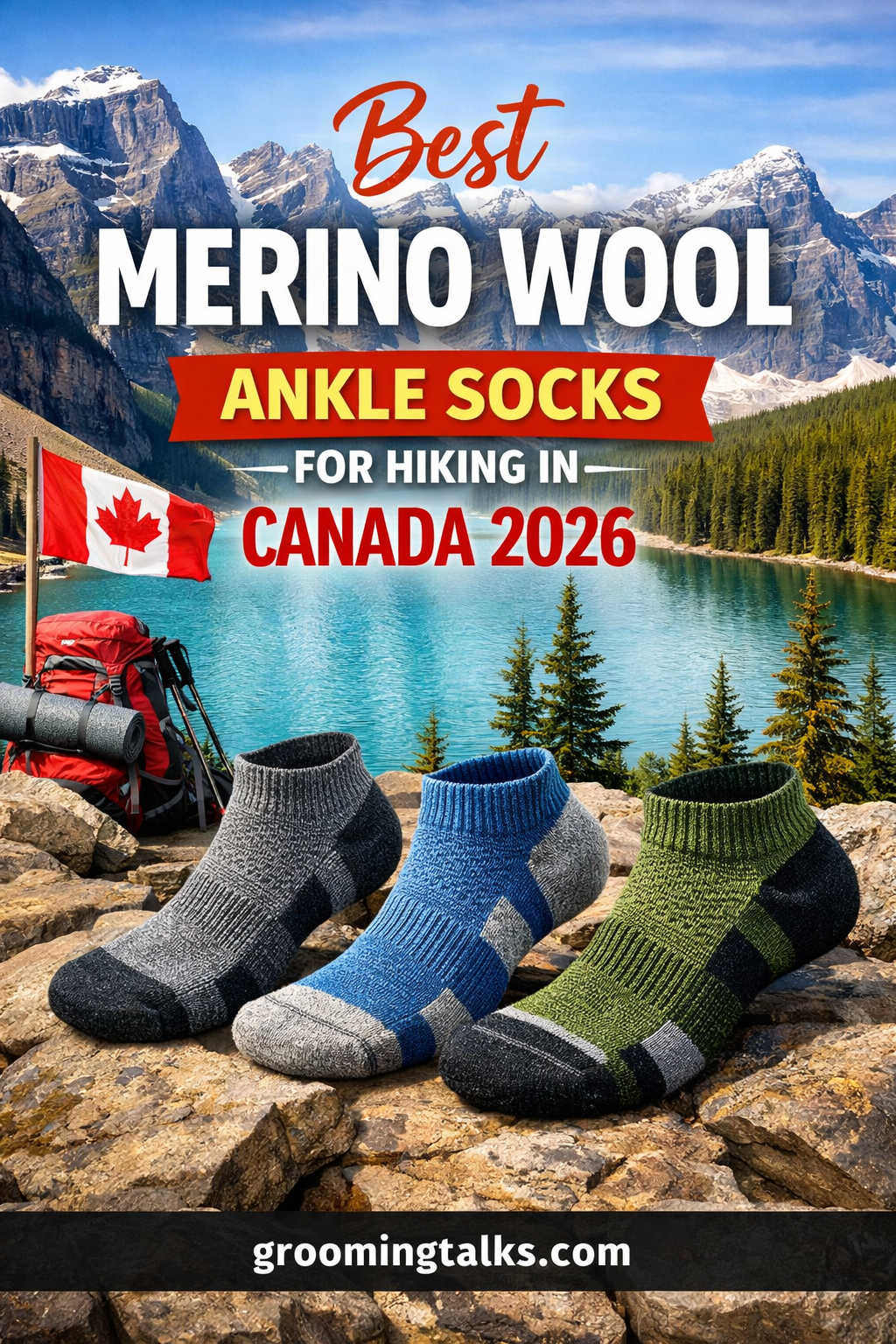
Your boots get all the glory. Your trekking poles get the Instagram shots. But your socks? They’re doing the quiet, unglamorous work of keeping your feet alive out there.
Ask any seasoned Canadian hiker what’s in their pack and merino wool ankle socks will almost always make the list. It’s not hype — it’s hard-earned preference. Once you’ve hiked a full day in properly fitted merino socks and come out the other side blister-free and odour-neutral, going back to cotton or cheap synthetics feels like a real step backward.
This guide is written for hikers who want practical, honest advice — not recycled marketing copy. We’ll cover what actually makes merino wool work on trail, what to check before you buy, which socks are worth your money in 2026, and how to match your choice to specific terrain across Canada.
Why Merino Wool Outperforms Everything Else on Canadian Trails
It’s fair to ask: why not just grab a decent synthetic sock and move on? For a short stroll, sure. But for hiking in Canada — where you might start a morning in full sunshine and finish it caught in a mountain thunderstorm — merino wool earns its place in ways synthetics genuinely can’t match.
It regulates temperature on its own. Merino fibers have a natural crimp that traps small air pockets. Those pockets insulate your feet in cold air and release heat when your body temperature climbs. On a shoulder-season hike in Kananaskis where temperatures shift 15 degrees between 7am and noon, that self-regulation is not a small thing.
It moves sweat without holding onto it. Cotton soaks up moisture and clings to it — that’s why cotton trail socks feel clammy fast and almost guarantee blisters on longer days. Merino pulls sweat away from your skin and pushes it outward to evaporate. Feet stay drier, and blisters become much less likely.
It holds warmth even when wet. This one is underappreciated. When merino gets saturated — say, from a stream crossing in the Selkirks or from persistent coastal drizzle in BC — it still retains meaningful insulation. Synthetics essentially shut down in those conditions. Merino keeps working.
The odour resistance is real. Lanolin, a natural oil in wool, creates an environment where odour-causing bacteria struggle to thrive. In practical terms, you can wear merino socks two or even three days in a row without the kind of smell that clears out a backcountry hut. On a week-long trip where you’re watching every gram, that matters.
It’s soft enough for a full day. Old-school wool was scratchy. Merino is different — the fibers are fine enough to flex against skin rather than irritate it. For hikers prone to hot spots or those with sensitive feet, that softness is the difference between a comfortable 25km day and one you’d rather forget.
What to Actually Look for Before You Buy
Merino hiking socks vary significantly in quality and build. These are the things that separate a sock that lasts three solid seasons from one that pills and thins out after a few months.
Wool percentage. Higher merino content — ideally 60% or above — means better moisture management, temperature regulation, and softness underfoot. The rest of the blend is typically nylon for durability and elastane for shape retention. Socks marketed as 100% merino are beautifully soft but tend to wear through faster on rocky terrain. For most trail conditions, a 60–75% merino blend is the practical sweet spot.
Cushioning weight. Ankle hiking socks come in three general weights. Ultralight or run-weight options are ideal for warm days and fast-packing where you want minimal bulk under your foot. Medium cushion is the most versatile — enough padding for rocky ground without overheating your feet. Full cushion suits cold conditions or very long mileage days where impact protection matters above breathability. For most Canadian summer hiking, medium cushion is the right starting point.
Toe seam construction. This feels like a minor detail until you’re on kilometre 18 of a long descent and a poorly finished seam has rubbed a raw patch into your little toe. Look for flat-seam or seamless toe closures. Most quality merino socks offer this now, but budget options sometimes skip it.
Heel fit. A sock that slips at the heel will bunch, bunching causes blisters, and blisters end hikes early. A contoured heel pocket — shaped to cup the heel rather than lying flat — keeps the sock anchored. Pair that with a firm arch band and the sock stays where you put it across long distances.
Ankle height. True ankle-cut socks sit just above the ankle bone and work well with trail runners and low-cut hiking shoes, which are increasingly popular on Canadian day trails. If you’re in mid or high-top boots, a quarter-crew or crew cut gives you the coverage that prevents boot collar abrasion.
The 5 Best Merino Wool Ankle Socks for Hiking in Canada
These five options earn consistent praise from Canadian hikers across different budgets, boot styles, and trail conditions. All are available to Canadians through online retailers or direct shipping.
1. Darn Tough Hiker Micro Crew Light Cushion — Best Overall
Darn Tough builds their socks to a different standard. Made in Vermont with 61% merino wool, these are knit on a finer gauge than most competitors — producing a denser, more resilient fabric that holds its structure season after season without stiffening up.
The reinforced heel and toe zones outlast what you’ll find on most other brands, and the seamless toe closure disappears from your awareness within the first few minutes of hiking. The arch band is supportive without being tight — your foot feels held, not restricted.
The unconditional lifetime guarantee sets Darn Tough apart from the entire category. If these socks wear out for any reason, you return them and receive a replacement pair. No receipts required, no conditions. For Canadian hikers who put serious mileage on their gear over many seasons, that guarantee shifts the value calculation entirely in Darn Tough’s favour.
Best suited for: Multi-day backcountry routes, rocky terrain like the Canadian Shield, high-mileage hikers who want socks that outlast everything else.
2. Smartwool Run Targeted Cushion Ankle Socks — Best for Trail Running and Fast Hiking
Smartwool has been refining merino hiking socks longer than almost anyone, and the Targeted Cushion Ankle reflects that experience. At 56% merino wool, these lean slightly more synthetic than some competitors — which shows up as added snap in the fit and durability over heavy use.
The design is built around a smart principle: cushioning only where impact actually happens. The heel and forefoot are padded; the midfoot and top of the foot stay thin and ventilated. For hikers who run warm or hate the bulk of uniformly padded socks, this zonal approach is a genuine improvement over older designs.
The fit is athletic and close, making these well-suited for faster movement — trail running, fast-packing, or any activity where a sock that announces itself on your foot would be a distraction. Widely available at MEC and Canadian sporting goods retailers.
Best suited for: Trail runners, fast-packers, summer day hikes in the Laurentians, Okanagan, or Gulf Islands where heat and pace are both factors.
3. Icebreaker Hike+ Light Mini Socks — Best for Sustainability-Focused Hikers
Icebreaker sources ZQ-certified merino, an independently audited standard that covers animal welfare, land stewardship, and farming ethics. For hikers who care about where their gear originates, that certification means something concrete beyond marketing language.
The Hike+ Light Mini uses 64% merino wool with a Lycra blend for consistent stretch recovery. The sock fits cleanly and closely without bagging, and the low cut sits right at or slightly below the ankle on most wearers — ideal when you want air moving freely around your foot on a warm trail day. Mesh ventilation panels on the upper foot accelerate drying further.
Construction quality is high throughout: the reinforced zones hold up through a full season of weekly use, and Icebreaker’s sizing tends to run true, which reduces the guesswork when ordering online.
Best suited for: Eco-conscious hikers, warm-weather day trips around Banff, Jasper, or Algonquin, travel where your hiking socks pull double duty as casual footwear.
4. Farm to Feet Madison Lightweight Low Cut — Best for Sensitive Skin
Farm to Feet doesn’t get the attention it deserves in Canadian hiking circles. The Madison Low Cut is made entirely in the United States — fiber, yarn, knitting, and finishing — using domestic merino wool. For hikers who follow ethical manufacturing closely, that level of supply chain transparency is uncommon and worth acknowledging.
What stands out on trail is the exceptional softness. Farm to Feet processes their merino in a way that produces a noticeably gentler feel underfoot than most blended hiking socks. For hikers who’ve dealt with irritation, hot spots, or skin sensitivity from other socks, the Madison Low Cut frequently solves the problem without requiring a compromise on trail performance.
The heel pocket fits snugly without slipping, the reinforced toe cap handles repeated use without thinning, and the price per pair makes it genuinely easy to keep a rotation of three or four on hand — which extends the life of each pair considerably.
Best suited for: Hikers with sensitive skin or blister-prone feet, those who want high merino content at a mid-range price, casual hikers building a multi-pair rotation.
5. REI Co-op Merino Wool Hiking Light Cushion Ankle Socks — Best Value
REI’s house-brand merino socks consistently perform above their price point. At 64% merino wool, the material quality holds up against brands charging significantly more, and the construction — while not as burly as Darn Tough — is solid enough for casual to moderate hiking use.
The light cushioning makes these a comfortable year-round option in mild conditions, and the structured arch band does a reasonable job of keeping the sock in position during movement. Sizing is consistent and tends to run true, which matters when ordering online for Canadian delivery.
These won’t outlast a Darn Tough sock over five years of demanding use, but for hikers who want quality merino ankle socks without premium pricing — or who want to rotate several pairs affordably — REI’s option is genuinely hard to argue against.
Best suited for: Beginners, casual weekend hikers, anyone building their first merino rotation without a large budget.
Matching Your Socks to Where You Hike in Canada
The right merino sock for coastal BC isn’t necessarily the right one for a Yukon backcountry trip. Here’s how to think about it by region.
British Columbia — Wet forests and alpine zones. BC coastal trails are often damp, muddy, and cooler than expected even in summer. Moisture management and tight weave construction matter most here. A medium-cushion merino ankle sock pairs well with waterproof trail shoes on wetter routes. In BC’s alpine zones, carry a spare dry pair — temperatures drop quickly above the treeline.
Alberta — Rocky Mountain terrain. The Rockies bring dramatic elevation changes and conditions that can shift from warm and clear to cold and windy within a single afternoon hike. Medium-cushion merino handles both the impact demands of rocky descents and variable temperatures well. In spring or fall, a thin liner sock underneath your merino ankle sock adds warmth without adding bulk.
Ontario and Quebec — Mixed forest and trail networks. The Bruce Trail, La Cloche Silhouette, Gatineau Park, and Mont-Tremblant all share hot, humid summer conditions. Here, breathability and odour resistance become the priority. A lightweight merino ankle sock with mesh ventilation keeps feet cooler and stays fresher than anything synthetic on long summer days.
The North — Yukon, NWT, northern Ontario. Remote northern hiking comes with wider temperature swings and less margin for error. Even in July, early mornings at elevation can hover near freezing. A medium to full-cushion merino sock handles dawn cold without overheating you by early afternoon. On any remote trip, carry a spare dry pair as a non-negotiable insurance item.
How to Make Your Merino Socks Last
Merino wool is more durable than its reputation suggests, but it rewards basic care habits.
Wash cold. Hot water causes merino fibers to felt and shrink — they lock together and don’t recover. Cold water on a gentle cycle preserves both the wool’s natural properties and the sock’s shape.
Skip fabric softener. Softener coats the fibers and clogs the natural channels that move moisture away from your skin. Over several washes, it quietly kills the moisture management that makes merino socks worth buying. A wool-specific detergent is all you need.
Air dry when you can. Lay socks flat after washing. If you use a dryer, use the lowest heat setting. Repeated high-heat drying shortens lifespan gradually in ways you won’t notice until the fabric starts thinning.
Rotate your pairs. Using the same pair daily concentrates wear in the same spots — usually the heel and ball of the foot. Rotating two to four pairs distributes that stress evenly and lets each sock recover its shape between uses. This single habit probably doubles how long your socks last.
Store them loosely. Balled-up socks stuffed in a drawer stretch the elastic over time. Rolling them flat or loosely maintains their shape in storage.
Frequently Asked Questions
Are ankle socks appropriate for hiking in Canada, or should I use taller socks?
For most warm-season day hikes with trail runners or low-cut shoes, ankle socks work well. They’re lighter and more breathable than crew socks in warm weather. Where ankle socks fall short is with mid and high-cut boots — in that case, a quarter-crew or crew sock covers the boot collar contact zone and prevents the rubbing that causes blisters at the lower shin.
How long does a quality pair of merino wool hiking socks actually last?
With regular use and decent care, most quality merino socks last one to three years. Darn Tough is the outlier here — their lifetime guarantee means worn-out socks get replaced indefinitely. If longevity is your main criteria, Darn Tough offers the strongest long-term value even at a higher initial price.
Is merino wool actually comfortable to wear hiking in Canadian summers?
Yes, and often more comfortable than synthetics in summer conditions. A lightweight merino ankle sock breathes well and actively moves moisture away from the skin rather than trapping it. In hot and humid conditions — think southern Ontario in August — merino feet come out noticeably drier than feet in cotton or mid-grade synthetics.
How often do I actually need to wash merino wool hiking socks?
On trail, most hikers wear merino socks two to three days before washing without noticeable odour. This is a practical advantage over synthetics, which usually need washing after each use. When you’re home and have the option, washing every one to two wears is a reasonable habit that extends sock life.
What merino wool percentage should I look for in hiking socks?
Aim for 60% or above. Below that, the moisture-wicking and odour-resistance properties weaken noticeably. The nylon and elastane in the blend aren’t a compromise — they add durability and help the sock maintain its shape. Pure 100% merino socks are very soft but wear through faster on rough terrain.
Where can I buy merino wool hiking socks in Canada?
MEC carries Darn Tough, Smartwool, and Icebreaker both in-store and online. Sporting Life and Altitude Sports stock major brands as well. Amazon Canada carries most options with quick shipping. REI ships directly to Canadian addresses, and Darn Tough’s own website ships internationally. Prices are occasionally better on brand websites during seasonal sales.
Will merino wool socks shrink if I wash them wrong?
Yes, if you use hot water or high dryer heat. Cold-water washing and air drying or low-heat machine drying prevents shrinkage almost entirely. Most quality merino hiking socks also receive a manufacturing treatment that improves machine-wash stability, but the cold-water habit is still worth keeping as a default.
Final Thoughts
There’s no single sock that works perfectly for every hiker, trail, and season. But merino wool ankle socks come closer to a universal answer than anything else on the market right now — particularly for the varied terrain and climate you encounter hiking across Canada.
If you’re new to merino, start with one pair. Take them on several hikes across different conditions. Pay attention to how your feet feel at the end of the day compared to what you were wearing before. That’s the most useful test — more reliable than any spec sheet.
Most hikers who switch to quality merino socks don’t go back. The comfort holds up over long days, the practical advantages are real rather than theoretical, and once you’ve completed a multi-day trip without worrying about blisters or sock odour, it’s difficult to see things any other way.
Pick a pair that matches your terrain, your budget, and your hiking style. Your feet will notice.